Common Core Unit Defined
|
A unit defined within the Common Core is a three to six week series of specific lessons, learning experiences, and related assessments based upon designated Essential Standards and connected Supporting Standards. A Supporting Standard are those standards that are related to and support the teaching of an individual Essential Standard or of the overall unit. Each unit of study should have at least one to two reading standards included as well as the Lexile range in complexity of text tied to material selection. Each unit should be named to give it meaning of purpose. One method in naming a skill based unit of study could be according to their purpose and the dominant Reading and Writing focus throughout the unit.
|
On the other hand thematic units have a different design, in that an essential question drives the theme of the unit. One way to outline the Essential and Supporting standards for a Common Core unit is to develop a Curriculum Web. To create an effective Common Core unit each Essential Standard should be represented in at least one unit and may appear in multiple units. In a growth curriculum Essential Standards will be split across multiple units especially if skills detected in a particular standard are determined in need of additional instructional support. In one unit an Essential Standard may be a supporting standard while in another unit the Essential Standard becomes a supporting standard. To determine the opportunity to learn standards becomes essential in a growth curriculum as it is measured within the zone of proximal development. The particular units of study should be named according to their purpose and the dominant Reading and Writing focus throughout the unit. When constructing a Common Core unit supporting standards like NET Standards need to be taken into consideration when building capacity for the development of 21st Century Learning skills. Units can be categorized into one of four types:
1. Thematic - emphasizes the use of an essential question or big idea to support the theme of the unit.
2. Genre based - emphasizes an approach with the whole text as the unit in focus rather than the sentence. The focus on the whole texts implies that there is higher level of order and patterning in language than just in sentence-grammar at the level of discourse organization and meta-patterning of grammatical features.
3. Skill-based—Emphasizes application (writing narratives; using context to determine meanings of words)
4. Topic-based--Emphasizes a cluster of skills related to one topic but that contains several skills
2. Genre based - emphasizes an approach with the whole text as the unit in focus rather than the sentence. The focus on the whole texts implies that there is higher level of order and patterning in language than just in sentence-grammar at the level of discourse organization and meta-patterning of grammatical features.
3. Skill-based—Emphasizes application (writing narratives; using context to determine meanings of words)
4. Topic-based--Emphasizes a cluster of skills related to one topic but that contains several skills
Thematic Units
Thematic units of study should be identified according to their purpose and the dominant focus as it is related to the essential question that drives the theme of the unit. The form of the unit will be developed through the focus of the essential question as standards are selected within the Curriculum Web. For a Common Core Unit to be successful, the theme must allow for many different areas of exploration and should relate to some facet of the students' lives so that it will capture their interest and give the unit a real-life application. When the curriculum connects with the students' lives and experiences, they are more likely to internalize what they learn.
The theme should be developed around an essential question. The essential question is the driving force behind the unit that supports instructional delivery as it refocuses the attention to what is important about the unit. For example an essential question for a particular unit might be "How Literature Effects Our Lives." As a theme for the unit, the statement becomes the introductory clause for each lesson. The teacher would consistently and periodically state to the class, "In today's lesson, we are going to further explore ways that literature effects our lives." The restatement of the essential question or theme of the unit then drives instruction and assessment
for a particular unit of study.
In the Common Core, assessments are performance based and how standards are tied together will determine the type of task required when designing end of unit assessments. It is important to remember that standards are not taught in isolation as each standard may carry different conceptual ties to performance reviews. That is why it is important that units include skills from multiple strands that relate to and reinforce one another as these skills within the standards are assessable with one integrated performance ask.
The theme should be developed around an essential question. The essential question is the driving force behind the unit that supports instructional delivery as it refocuses the attention to what is important about the unit. For example an essential question for a particular unit might be "How Literature Effects Our Lives." As a theme for the unit, the statement becomes the introductory clause for each lesson. The teacher would consistently and periodically state to the class, "In today's lesson, we are going to further explore ways that literature effects our lives." The restatement of the essential question or theme of the unit then drives instruction and assessment
for a particular unit of study.
In the Common Core, assessments are performance based and how standards are tied together will determine the type of task required when designing end of unit assessments. It is important to remember that standards are not taught in isolation as each standard may carry different conceptual ties to performance reviews. That is why it is important that units include skills from multiple strands that relate to and reinforce one another as these skills within the standards are assessable with one integrated performance ask.
Establishing a Rigor and Relevance Framework
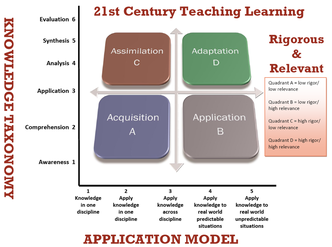
Rigor and Relevance Framework
The third step is to use the Common Core Unit Development Template to establish the level of rigor and relevance that will be assigned to each standard selected for the unit. In this process the PLC team will place the indentified common core standards derived from the Curriculum Web on the Unit Development template to determine the level of complexity for each standard. This process of framing-up rigor and relevance, that are matched to common core standards is referred to as “unpacking” standards. To accomplish the work the PLC team will have to ask essential questions that hover around the central theme of the lesson that provide higher levels of understanding and evidence of real life applications.
The process requires the PLC team to sequence all the elements of the selected standards for the unit into a coherent, workable framework of knowledge level and application. The critical elements to the success of the unpacking process is determining the depth and rigor by applying the Rigor and Relevance Framework, the scaffolding of skills using Depth of Knowledge Chart, and providing clear and concise language for students (Student Friendly Language).
The process requires the PLC team to sequence all the elements of the selected standards for the unit into a coherent, workable framework of knowledge level and application. The critical elements to the success of the unpacking process is determining the depth and rigor by applying the Rigor and Relevance Framework, the scaffolding of skills using Depth of Knowledge Chart, and providing clear and concise language for students (Student Friendly Language).
|
The process requires the PLC team to sequence all the elements of the selected standards for the unit into a coherent, workable framework of knowledge level and application. The critical elements to the success of the unpacking process is determining the depth and rigor by applying the Rigor and Relevance Framework, the scaffolding of skills using Depth of Knowledge Chart, and providing clear and concise language for students (Student Friendly Language). This can be accomplished through the use of Common Core Unit Development Template as the PLC team applies the Rigor Relevance Framework to each standard. To clearly define the work of unpacking a standard requires each member of the PLC team to seek out a deep understanding of what is meant by rigor and how rigor is correlated within the dichotomy of relevance.
|
Depth of Knowledge with Karin Hess from DOE on Vimeo. |
- Rigor in the traditional since simply means the complexity of the written task as it relates to the depth of knowledge. In other words, what verbs are used to determine the taxonomy level (order of competencies) that describes the task.
- Relevance is on the flip side of the dichotomy, as it provides a description of complexity of the task as it relates to application of the task to real world problem solving. Relevance extends the learning beyond the classroom by teaching students to apply what they are learning to real world situations. To test
relevancy within the framework the PLC team would need to plot the task on one of the four aplication quadrants.
Resource Link: The Rigor Relevance Framework is a tool developed by staff of the International Center for Leadership in Education to examine curriculum, instruction, and assessment. The Rigor/Relevance Framework is based on two dimensions of higher standards and student achievement. (See Rigor Relevence Framework Tool) by ©International Center for Leadership in Education
To review how the region relevance model is applied to unpacking standards see: "Highly Effective Learning and the Rigor-Relevance Model" by Linda Jordan
Developing Authentic Learning Task
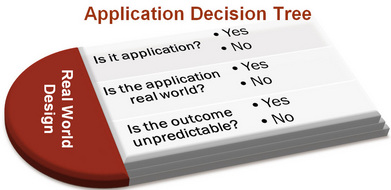
A good task is authentic and requires the student to perform in a real-life context. According to Melinda Kolk, The authentic, or real-world, nature of the task frames student work in a relevant and interesting way. The world of work provides many contexts for authentic tasks,.....by requiring students to solve a real-world problem, an authentic task creates a bridge between the content learned in the classroom and why this knowledge is important in the world outside of it. Much of what we ask students to complete in the classroom is contrived. Life in the real world doesn’t usually ask you to choose from provided options A, B, C, or D. An authentic task can help teachers make classroom work relevant to students by asking them to make these real-world decisions."
An authentic task can be multidimensional and require not only cognitive skills but also interpersonal skills and abilities. The tasks should always reflect the Common Core standards. The task will not elicit quality work if it requires knowledge and skills that the students do not have. It will also result in considerable frustration on the part of the students and the teacher. The PLC unit development team are to specify what knowledge will be gained through the development of learning text and the Lexile range attached to each task.
The Common Core State Standards Initiative places a strong emphasis on the role of text complexity in evaluating student readiness for college and careers. The Common Core Standards devote as much attention to the text complexity of what students are reading as it does to how students read. As students advance through the grades, they must both develop their comprehension skills and apply them to increasingly complex texts. The proportion of texts that students read each year should come from a particular text complexity grade band. Students must also show a steadily increasing ability to discern more from and make fuller use of text. Lexile Framework
The PLC Team also should identify the learning domain that will be assigned to task within the unit. An excellent way to understand what is involved in moving to new Common Core State Standards and their related assessments is to use the Rigor/Relevance Framework. It should include information about the levels of learning by identifying learning activity domains that will support the unit.
An authentic task can be multidimensional and require not only cognitive skills but also interpersonal skills and abilities. The tasks should always reflect the Common Core standards. The task will not elicit quality work if it requires knowledge and skills that the students do not have. It will also result in considerable frustration on the part of the students and the teacher. The PLC unit development team are to specify what knowledge will be gained through the development of learning text and the Lexile range attached to each task.
The Common Core State Standards Initiative places a strong emphasis on the role of text complexity in evaluating student readiness for college and careers. The Common Core Standards devote as much attention to the text complexity of what students are reading as it does to how students read. As students advance through the grades, they must both develop their comprehension skills and apply them to increasingly complex texts. The proportion of texts that students read each year should come from a particular text complexity grade band. Students must also show a steadily increasing ability to discern more from and make fuller use of text. Lexile Framework
The PLC Team also should identify the learning domain that will be assigned to task within the unit. An excellent way to understand what is involved in moving to new Common Core State Standards and their related assessments is to use the Rigor/Relevance Framework. It should include information about the levels of learning by identifying learning activity domains that will support the unit.
Resource Link: Creative Educator by Melinda Kolk
Open Source Web 2.0 ToolsTied to this process is the three technology domains that have been establised to suport the Common Core standards that have been selected within the unit development template. These domains are open source software applications that define how technology could be used in the unit to support the authenticty of the task. For example, one of the identified authentic task for a unit might support data gathering and synthesis. Students experiencing the unit will be required to interact with technology to obtain the information necessary to complete the assigned task. They will be asked to research information and then report their information electronically.
|
 Select Picture to Enlarge |