The Interactive Flipped Classrooms
To teach in the Flipped classroom requires teachers to capture effective instructional practices and applying those practices to high engaging lessons that are integrated to fit different modalities of learning. As experts on the human brain tell us, if there's no emotional engagement, there's no learning. When you understand students' interests, desires and thinking, and you let them know you understand, you enter their world, rather than teaching
strictly from your point of view.
strictly from your point of view.
|
The selection of appropriate interactive follow up activities in a flipped classroom has limited value unless students really understand it, and real understanding of a specific Common Core standard comes when students have opportunities to interact with each other regarding their perceptions of the lesson. To help students interact with each selected Common Core standard for learning, strategies must be designed that support the identified purpose for learning standard selection: group awareness, knowledge acquisition, attitude development, the identification of present practices, or the prioritization of knowledge.
|
|
For example, interaction strategies that support identifying present practices could require the students to ganize information, to check their understandings, and/or to compare the information to their own personal experiences. Without interactive strategies, the classroom can become densely informational, which will put students in a position of sustained passive listening. Because the limit of working memory is about seven items of information, a highly technical screen cast should present no more than five important facts before students have a chance to interact in order to process the data. For less fact-intensive topics, processing time could occur at regular fifteen to twenty minute intervals.
Building Blocks for Flipped Classrooms
Keeping students' brains attentive and focused in the classroom is an important reason for developing interactive classroom environments. In the flipped classroom teachers need to be aware of possible attention lapses and be
ready to implement attention-focusing interaction activities.
Small-group interactions are the basic building blocks for interactive lessons because they keep students focused and help them to construct meaning from their experiences. Small-group interaction activities involve two or more persons and are traditionally set as quads with preferably no more than five persons per group. Small-group activities in a flipped classroom environment have a number of advantages:
ready to implement attention-focusing interaction activities.
Small-group interactions are the basic building blocks for interactive lessons because they keep students focused and help them to construct meaning from their experiences. Small-group interaction activities involve two or more persons and are traditionally set as quads with preferably no more than five persons per group. Small-group activities in a flipped classroom environment have a number of advantages:
1. They provide for the relatively easy and certain involvement of everyone.
2. They permit and encourage meaningful participation in a low-risk, threat-free way.
3. They provide participants an opportunity to learn from peers and to test out the validity of their own ideas.
4. They can provide the diversity of views essential for good problem solving.
2. They permit and encourage meaningful participation in a low-risk, threat-free way.
3. They provide participants an opportunity to learn from peers and to test out the validity of their own ideas.
4. They can provide the diversity of views essential for good problem solving.
Teachers who instruct in a flipped classroom will need to make decisions on when it is most effective to use a small group process for interaction and then select an appropriate interaction strategy. A list of small group interactive strategies is posted below.
Small Group Brainstorming
Prospectus Building
Small Group Discussion
Talking Tokens
Cooperative Checkup
Jigsaw
Co-op
Focus Worksheet
Small Group Brainstorming
Prospectus Building
Small Group Discussion
Talking Tokens
Cooperative Checkup
Jigsaw
Co-op
Focus Worksheet
Provision of Visual Orientations
When presenting new information on screen cast, vodcast or podcast, visuals become important tools to the learners. The teacher’s task in developing reference information for posting purposes is to provide multiple forms of input by providing the information through both auditory and visual modes. Consequently, the teacher’s responsibilities will be to design visuals that support and emphasize the main points of the topics as well as structure the interaction strategies. The visual aides will help the students to construct the richest possible learning.
|
An important consideration when developing visuals is how they may affect inactive listening among group members. By nature, individuals attending an interactive lesson for the first time will try and spend great amount of their time copying notes from visuals and not listening. To avoid such problems, it is recommended that the presenter provide copies of important visuals, in the order of their presentation, to all students. This will allow the students to focus their attention on what is being said and allow them to elaborate their ideas on the visuals in front of them. The link for Guidelines for Designing Visuals is a set of
guiding principles for designing visuals for a flipped classroom. |
|
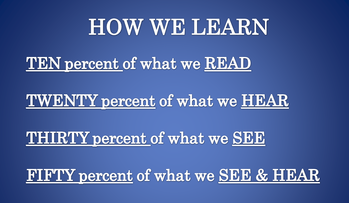
When designing meaningful strategies for communications, effective visuals can greatly impact learning. The exhibit below (How We Learn) reveals that when learners receive information auditorily, their learning is increased by only 20%. However, when the learners are able to both see and hear new information, their learning increases by 50%.